Showing posts with label Harini. Show all posts

Harini and her mother have a picnic, and the ants and the beetles are happy

Harini and her mother have a picnic in the garden

It was Sunday.

In Lonavala, Sunday meant no school, no hurry, and Amma saying, "We will do something nice in the evening."

The sky was soft after the afternoon heat. The Western Ghats in the distance were a pale blue, and a small wind was moving through the garden, shaking the mango leaves.

Harini was in her yellow t-shirt and blue denim skirt, flip-flops slapping on the gravel path. Her mother had a straw basket in one hand and a steel thermos in the other.

Harini and her mother decide to have a picnic in the garden 
[Image sourced from Meta AI. Query and character copyright - Bharat Bhushan]

"What is in the basket, Amma?" Harini asked, skipping ahead and then running back.

"Groundsheet, sandwiches, and a small surprise," her mother said. "Where shall we have our picnic?"

Harini did not even have to think. "Under the banyan! The Great Banyan in the centre. It is the coolest place."

Her mother smiled. "As you command."

They walked down the mud trail behind the cottage, past the Champa bush where the white flowers were just opening for evening. The Great Banyan stood huge and kind in the middle of the garden, its aerial roots hanging down like long, gentle arms. Under it, the ground was clean and shaded.

Amma spread the blue and white checkered groundsheet. She had made cucumber-tomato sandwiches, cut into triangles. From the thermos, she poured thick mango milkshakes into two steel cups.

"Amma, did you bring the sugar-honey?" Harini asked.

"I did," said her mother. She took out a small wax paper sheet, folded like a boat, and inside was a spoonful of sugar mixed with honey, glistening gold and white. "For dipping the sandwiches. You like it sweet."

Harini nodded seriously. "Like the sunbirds."

They sat and ate. A pair of bulbuls were chattering above them in the banyan.

Harini and her mother set up their picnic and snacks at the banyan tree
[Image sourced from Meta AI. Query and character copyright - Bharat Bhushan]


"Harini! You came!" called one bulbul. It was the bulbul that Harini had seen last week.

"I can see you. We have picnic," Harini whispered up.

"We saw," said the bulbul. "We will not steal. Your Amma is watching."

Harini giggled. Amma thought she was giggling at the sandwich.

Just then, at the edge of the groundsheet, where the mud trail met the roots of the banyan, Harini saw something.

A line. A perfect, straight, moving black line.

Harini spots a line of black ants moving about near the picnic spot.
[Image sourced from Meta AI. Query and character copyright - Bharat Bhushan]


Black ants. Camponotus. The big carpenter ants.

They were marching single file, each carrying a tiny speck of something — a leaf bit, a grain.

"Oh!" Harini leaned forward. "Something there..."

Her mother looked. "Ants, kanna. Don't disturb them."

But Harini was already fascinated. She remembered the last time, near the little monsoon stream that cut across the trail. Now they were here, near their picnic.

In her mind, she could hear them, small and busy voices.

*"Left, left, left, left..."* one ant was saying.

"Heavy! Heavy! This crumb is bigger than my house!" said another, dragging a tiny piece of biscuit that had fallen earlier.

"Road is long. Road is long. Keep straight," said the leader ant, touching his antennae to the ground.

Harini looked at her sandwich. Quickly, carefully, she pinched off a few crumbs and some tiny sugar granules from the sandwich edge and scattered them a little away from the groundsheet, on the mud, in the ants' path.

Harini shares some sugar granules and bread crumbs with the ants.
[Image sourced from Meta AI. Query and character copyright - Bharat Bhushan]


"What are you doing, Harini?" her mother asked, sipping her milkshake.

"Helping," Harini whispered. "They are working so hard."

She scattered a few more sugar granules and some very tiny bread crumbs near the line, not on it, but just beside it, so they would find it.

The ants stopped. Their antennae wiggled wildly.

"Sugar! Sugar! Sweet star dust!" shouted a small ant.

"Bread! Bread! Soft mountain! Call everyone!" said another, running back and forth excitedly.

The leader ant came forward, touched the sugar with his antennae, and looked up at Harini. Or at least, Harini felt he looked up at her.

"For us? You giant-yellow-shirt giant?" he asked.

Harini nodded, her ponytail bouncing. "For you. And your friends."

"Thank you, Harini-who-talks," said the leader ant. "We will carry it home. The little ones will be happy tonight."

Her mother was watching all this. She didn't hear the ants, of course. She just saw her six-year-old daughter crouched at the edge of the sheet, very carefully placing crumbs on the earth, her face full of concentration and kindness.

Amma's eyes softened. She didn't say anything. She just let her daughter do it.

After a while, the milkshakes were over. The sandwiches were over. The sun was lower, and mosquitoes were beginning to hum near the dense papaya-banana corner.

"Shall we go back, Harini? We need to feed the cows. Lakshmi and Gauri will be waiting with the calf," Amma said.

Harini got up and helped fold the groundsheet. Her mother picked up the thermos, the cups, the basket. As they started walking back towards the cottage on the mud trail, Harini looked back.

Harini notices that her mother has forgotten the sugar and honey mx
[Image sourced from Meta AI. Query and character copyright - Bharat Bhushan]


"Amma! You forgot!"

On the ground, where the groundsheet had been, was the wax paper sheet with the spoonful of sugar mixed with honey. It was shining in the evening light.

Harini ran back. "Should I pick up the wax sheet with the sugar and honey? We will need it?"

Her mother turned, looked at the wax sheet, then looked at Harini, and at the little scattering of sugar and crumbs Harini had left for the ants.

Then her mother smiled. That slow, knowing smile mothers have.

"Let it be," she said. "Let it be, for it would be good for Harini's ant and beetle friends."

Harini stared. Her mouth opened.

"You saw? You saw I gave them sugar?"

"I saw," Amma said, tucking a strand of hair behind Harini's ear. "I saw my daughter being kind when she thought no one was looking. That is the best kind of kindness."

Harini's cheeks went pink. She was surprised and very, very happy. "You are not angry that I wasted bread?"

"Arrey, a few crumbs for ants is not waste," Amma said. "The garden gives us mangoes and guavas and champa flowers. We can give a little sugar back."

Harini hugged her mother's waist.

Just then, there was a rustling at the wax sheet.

"Ohhh! Ohhh! What is this! What is this shining lake!"

Two big, shiny black dung beetles had trundled in from the direction of the cow shed near the tamarind tree. Their backs gleamed like polished buttons. Behind them, the line of black carpenter ants had already reached the wax paper.

"Sugar! Honey! Mixed together! The moon and the sun together!" shouted the ants.

The ants and the dung beetles discover the sugar and honey mix at the picnic spot
[Image sourced from Meta AI. Query and character copyright - Bharat Bhushan]


The first dung beetle, a little older and slower, pushed his head into the edge of the honey.

"Mmm. Mmm. The humans left us kheer," he said in a deep, slow voice.

The second beetle, smaller, was almost dancing.

"Too sweet! Too sweet! My legs are sticking but my heart is flying!"

Harini crouched down again, just a few feet away. She could hear them all.

"Is it good?" she whispered.

The leader ant looked up, his mouth full of honey-sugar.

"Good? Harini-who-talks, it is not good. It is a festival! We have never had honey-sugar river before!"

The big dung beetle looked at Harini and bowed his shiny head.

"Thank your mother, little speaker," he said. "Tell the tall lady that we beetles also say thank you. We came for dung, but we found gold."

Harini turned to her mother, eyes shining. "Amma, they are saying thank you! The ants and the beetle uncle!"

Her mother laughed. "Then we must say you are welcome."

She did not hear the beetles, but she believed Harini did. That was enough.

Hand in hand, they left the wax paper sheet under the Great Banyan, with the line of black ants and the two dung beetles having a quiet, sticky feast in the shade.

Harini and her mother return to their house while 
the ants and the dung beetles are happy with the honey and sugar mix
[Image sourced from Meta AI. Query and character copyright - Bharat Bhushan]


As they walked back on the mud trail towards the cottage, the bulbuls above sang a good-night song, and Harini whispered back, "Good night! Good night! See you tomorrow!"

And somewhere behind them, a very small voice said, "Good night, Harini-who-talks. And thank you for the sugar stars."


(c) Dr. Bharat Bhushan, 25 September 2026

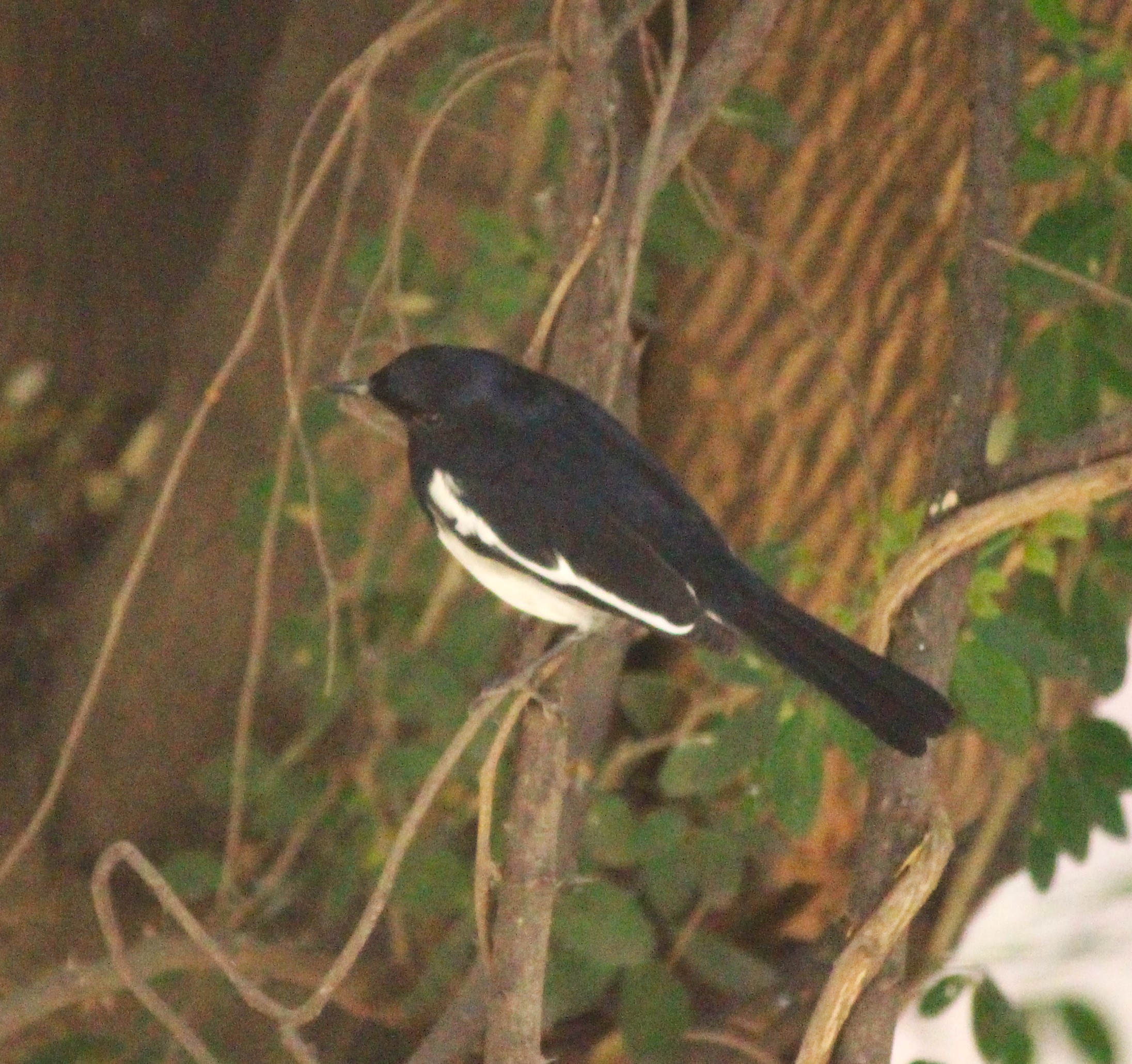
Harini gets to know why Dominga and Domingi, the magpie robins, are upset with one another

Harini gets to know why Dominga and Domingi, the magpie robins, are upset with one another 

Darzee and Darzi, the tailor birds were puzzled. They could hear the arguments, loud whistling calls that went back and forth between Dominga and Domingi, the Magpie Robins. They had been arguing about something for some time. They were flying about, flitting here and there, amongst the flower bushes below the great old banyan tree at the corner of the garden.

Darzee flew up to Domingi and asked, “What is the matter? Why are you so upset? The two of you will disturb the entire garden and the other birds inside the banyan tree. Did something go wrong?”

Domingi gave a sharp whistle, and pointed towards her partner. “It is Dominga. He will simply not listen. I have told him to be careful and yet, he slips up. You know that we have to absolutely protect our nests and eggs. I am helpless when I am in the nest. It is Dominga, when he is flying about, who has to keep a watch and be on the alert.”

“I hope you are not anywhere near the nest now, while you are whistling and arguing so loudly,” Darzi asked Dominga. “That would be very foolish. Everyone, the birds, especially the crows, hidden away in the tall Asoka trees in the neighbouring garden, are all watching, looking at you.”

Dominga whistled, an angry tone, loud and shrill, and quietened down, perched on the branches of the Chafa tree, away from the banyan tree and the flower bushes below it. “No, No. We are not near the nest. Even Domingi is away from it. I was not careful today but Domingi blames me every day.”

Meanwhile, Harini, the 4-year old girl, hearing the loud whistles and calls of the Magpie Robins and watching them fly about with the two tailor birds, walked out of the house and came up to the Chafa tree. Darzee flew out of the banyan tree and came to a branch near her and called out, softly.


Harini saw Darzee, and said, “I hope everything is ok. If you want, I can go and call my Daddy. He will come out and scare it away, whatever is frightening you all and making you upset.”

Darzee laughed, in a musical whistle, “No. There is no need to call anyone. We cannot depend on you or your Daddy to help us. We have to help ourselves and manage it amongst us. Come, let me introduce you to Dominga. He did something wrong, like he does, every day. Domingi is angry.”

Darzi and Dominga flew down to the lower branches and perched nearby. Darzee asked, “What did you do wrong, Dominga? Even Harini, our friend in the garden, she who watches us from her window above the Chafa tree, is very curious. She wants to know if she can help us if you want her to.”

Dominga whistled in a low tone, “Hello, Harini. I have seen you at your window and while you were walking about in the garden. I know that you talk to Darzee and that the two of you are good friends.”


Harini smiled, and asked, “What happened? All of a sudden, there were these many loud whistles.”

“It was Domingi, my partner, who was upset,” Dominga replied. “I was not alert. It seems that Kokila, the female partner of the Koel, came quite close to our nest. I was watching Koel and looking out for hidden crows. I did not notice Kokila moving about stealthily, almost unseen, searching for nests.”

“Why are you so worried about Koel and Kokila,” Harini asked. “They are very quiet and never seem to talk to the other birds. They are always hidden in the large trees in the other gardens and are very rarely seen in the chafa tree. But, they never come to the bird feeder or to the bird bath.”

“The quieter that they are, Koel and Kokila,” Darzi said, looking around warily, “the more dangerous that they are. They search for our nests and we are always careful with them. Kokila is very clever. She is never seen but if we are not at our nests, she will come in and remove one of our eggs and replace it with her own. She will throw away our egg. She is very stealthy. We will have a big loss.”

“Kokila will steal your eggs?” Harini gasped. “How terrible. Why does she do that? Please go and talk to Domingi. She must be very frightened.”

Darzee nodded, and said, “I will let you know all about Koel and Kokila, sometime later. Now, let me go and talk to Domingi.”


The fifth of the very short stories about the birds in Harini's garden 

Bharat Bhushan 11 April 2025


Harini listens to the song of Dominga, the Magpie Robin


Harini’s mother looked angry. “Come on, eat up your breakfast. We need to get you to your kindergarten school in time. You may be punished for being late.”

Harini knew her strategy well for such moments. She put up her innocent face, pouted slightly, and spoke in a sing song voice, “Let me sit in Daddy’s open jeep in the garden and eat my breakfast. I will finish it quickly. We can go to the school directly from the garden after you get ready.”

Before waiting for her mother to answer, Harini picked up her breakfast plate, spoon and water bottle and ran out to the garden. She had prepared for it, already. A wooden box was kept in place for her to climb on and get in to the front seat of the open jeep. She could now have her breakfast and also take a look around the garden and see if she could spot any of the birds or butterflies or grasshoppers. Some portion of the Chafa tree’s shadow came over the vehicle and Harini was happy about it.

Sure enough, the male Magpie Robin, the handsome black and white colored bird, was perched on the outer branches of the Chafa tree and calling out in song, in a shrill, loud tone, with long whistles. ‘Wonder why was he calling out so loudly,’ thought Harini. ‘Darzee had told her that the tailor birds had different reasons for their many short and long whistles and calls. Did the Magpie Robin also change its calls?’


Waving her spoon, Harini called out to the Magpie Robin, “Why are you calling out so loudly, so early in the morning? Do you want some breakfast? I can share some of my fruits and milk.”

The Magpie Robin did not reply. From a nearby branch, Darzee, the female tailor bird, flew down to the bonnet of the jeep and looked inside Harini’s breakfast plate.


Darzee said, “That is Dominga, the male Magpie Robin. He is usually very busy in the mornings and evenings in calling out with his very loud display call. What are you eating? That looks very funny. Do you want me get you some insects and flowers to eat?”

Harini laughed. “Yes. I would love to show the insects to my mother and tell her that I am going to eat them. She will scream in fright. Why is Dominga, the male Magpie Robin calling out so loudly? Is he threatening the other birds and warning them not to come to the Chafa tree?”

“Dominga is just like that,” Darzee replied. “He calls out to the other male Magpie Robins and tells them that he is at the Chafa tree and that the others can go to some other trees. But, he is usually calling out to Domingi, the female Magpie Robin, who is at her hidden nest, on their eggs, and being careful about letting anyone know her location.”


“Oh! That is so wonderful. Another nest!” Harini clapped her hands. “Do you know where is it?”

Darzee whistled in mock anger. “Yes. I know where Domingi has her nest. No. I will not show you the nest or point it out to you. The nest will be in danger. There are always others who are watching, waiting for us to make a mistake. They even notice the direction that you are pointing to, and also can wait very patiently.”

“Yes, Yes. You had warned me,” Harini said. “I have to go to school now, and will return at noon. Can you get me to talk to Dominga and Domingi? I love Dominga’s song. Why does he sing?”

“I guess he is being clever,” Darzee said. “He is singing loudly so that all the hidden watchers are looking at him. Domingi can quietly get out of her nest and flit about the low bushes before she allows herself to be seen in the upper branches.”

“That is very smart,” Harini replied. “There, my mother is coming over to pull me out of this vehicle. I will meet you when I return from school. I love Dominga’s long whistling song. Let me try and practice that when I am going to school.”

Bharat Bhushan

11 April 2025

Darzee explains to Harini about how the tailor birds talk to one another.

Harini walked back to the great big old banyan tree and its wonderful canopy with all the flower bushes, grasses, weeds and thorny rose bushes that had gone wild by the corner of their garden. She did not want to disturb Darzee and Darzi, the tailor birds, at their nest. So, she walked carefully away from the bush that had the nest and came up to the tall rose bushes.

She called out softly, singing the nursery rhyme that was taught in school today. It went something like, 'Mary had a little lamb', or whatever. She was happy singing her own song, 'Meera had a sparrow,' a nursery rhyme that she had made up all by herself while returning on the school bus.

Darzee flew out from her flower bush and went about perching on 3-5 other bushes before coming nearer to Harini.


Darzee asked, "What is it that you are singing? I could hear it as you walked by the banyan tree. Thank you for not coming nearer to our nest."

"Oh, that's just a song that I made up," Harini replied. "But, you and your family, the other tailor birds, are always whistling and singing whenever you are flying about in the Chafa tree near my bedroom window and also in all the flower bushes. Why do you keep whistling?"

"Whistling?" Darzee smiled. "Yes. That is the way we talk to one another. There are many whistles and each one means something different. That is our language."

"Wow! You talk through whistles?" Harini exclaimed. "I would love to learn that. My father would be puzzled if I start talking to him by whistles. I could teach that to my friends in school."

Darzee laughed, in a long whistle. "It is easy to learn, if you sit quiet, observe, watch us carefully and understand why we whistle out the way we do. The short whistles are contact calls. We use that to let other tailor birds know that we are close by, though they may not easily see us inside the bushes."

"But, you have that other long musical whistle, very loud, that I love to hear," Harini said. "I know that it is the call of the tailor bird, 'towhee-towhee-tweee-tweee-towhee', or something like that. I am trying to learn that and will soon call you with that whistle from my bedroom window.

"Yes. But we have several different ones, when we call out loudly," Darzee replied, laughing. "I will not tell you about them so easily. You need to listen carefully, and watch out for what we are doing at that time."

"I did hear some different ones," Harini said. "Whenever I hear the long call, I know it is you and your family. It is only after I observe you all for some time that I hear the other calls and whistles. How do you know which one is which?"

Darzee laughed in her typical short whistle. "The calls and the whistles, these are certainly what we learnt from our parents, I think. They would call out when we flew together, and sometimes, they would call out in a short and loud whistle, one burst, and would stop. We would all stop. We do not know if there was danger about, but we knew that whistle very well."

"But, all tailor birds have the same sort of whistles, long or short, musical or not," Harini said. "How do you know that they are your parents or the tailor birds from another family? Do you all not get very confused?" 

"We make sure that we stay in eye contact, mostly," Darzee replied. "Tailor birds from other families do join us, whenever we announce that a certain tree or a branch within the banyan tree has a long line of ants or other insects moving about. We like to share with the others, you know. The other birds, those that love to eat ants and insects, they also join in. I do not know how they know but they do know that there is good feeding nearby." 

"Ok, I understand," Harini smiled. "I will keep a close watch on you and your family. Let me see if I am able to understand your calls and whistles."

Darzee continued, "Let me know if you can guess the purpose of each whistling call. I will also ask Darzi to tell the other tailor birds to call out loudly whenever they see you in the garden or at your window."

Harini smiled and was very happy. This was going to be fun, learning about the way the tailor birds talked to one another.

Bharat Bhushan
10 April 2025

Harini learns how the tailor birds decide to make their nests

Harini sat at her bedroom window, gazing out at the garden and the great big banyan tree in the distance. She loved watching the birds flit about, their feathers a riot of colors against the lush green foliage. Her eyes drifted to the shallow bird bath she had placed near her window, and she smiled as she saw a few birds sipping water from its edge.

As she sat there, keenly observing, she noticed the tailor birds flitting about the chafa tree that grew closer to her window. The inner canopy of the tree was a favorite haunt of the birds, darting in and out of its leafy depths. Harini loved watching them since the upper canopy of the Chafa tree was just outside her bedroom window on the first floor.


One of the tailor birds flew out of the Chafa tree and came to perch on the windowsill, looking in at Harini with bright, curious eyes. It was Darzee, the female Tailor Bird.


"Hello, Harini!" Darzee chirped. "Why did you not come to the banyan tree today? We were expecting you."


Harini smiled, feeling a little guilty. "I just got back from school, and I was waiting for lunch. I will come to the garden later this evening, I promise."


Darzee nodded, seeming to accept Harini's explanation. "We were a bit worried about you," she said. "But we are glad you're okay. By the way, what is a 'school' that you said you went to?"


"A school?" Harini asked. "Do you not know what is a school? That is where we are sent to learn everything. Nowadays I am learning alphabets and some poems. My father said that as I grow older, I can learn engineering and medicine. Then I can construct big buildings or learn how to treat people who are ill." 


"Don't you birds have a school?" Harini asked. 


"No. We do not attend a school and we have no teachers," Darzee replied. "All tailor birds know that as they grow older, they have to, with their partner, select a bush with large leaves that will not wither or fall away, look for a strong branch, avoid locations that can be seen easily, and stitch up the leaves to make our nests."


"But how do you learn to do this?" Harini asked. "How do you know which leaves to choose? How do you know how to stitch them together? I guess you have to protect them from the rain and the sun. I get so upset when it is very hot outside. But, I enjoy the rain."


"We cannot risk the rain or the sun," Darzee said. "The eggs have to be carefully protected. The body heat from our bodies is enough. Not more than that. The rains will make the entire nest wet and heavy and will cause it to fall down. So we have to choose carefully. Nobody teaches us. We learn by watching other tailor birds select their nest locations and also by observing the nest material that they pick up with great care. The stitching of the leaves, well, we do not go to any school and our parents certainly do not teach us."


"Nobody teaches you this?" Harini asked. "I thought that your mother taught you all this when you were in the nest. You are amazing, Darzee. I am so happy that I met you. I can learn so much by just watching you." 


Darzee laughed in a whistling tone and flew off to join her family at the Chafa branches as they kept searching for insects. Harini waved at the tailor birds and she was sure that one of them waved back at her.


Bharat Bhushan

8 April 2025


Harini meets Darzee and Darzi, the Tailor Birds


Harini walked slowly through the garden, making her way through the flower bushes and vegetable creepers below the great big banyan tree, her t-shirt barely protecting her from the snappy branches of the thorny bushes. She loved exploring the garden and the larger trees, and today she was on a mission to find some new friends. As she approached the large banyan tree, she spotted a tiny, intricately sewn nest, made by stitching together large leaves of a bush nearer to other flower plants, hanging from a branch. A female Tailor Bird, Darzee, was perched on a nearby branch, watching Harini with curious eyes. 


Harini's face lit up with excitement. "Hello! I'm Harini! I live in the house nearby," she exclaimed, her voice barely above a whisper.


Darzee tilted her head to one side, her greenish feathers rustling softly. "Hello, Harini! I'm Darzee. And that's my husband, Darzi," she said, nodding towards a nearby bush.

Harini followed Darzee's gaze and spotted the other Tailor Bird, Darzi, who actually looked the same, peeking out from behind a leaf. He gave her a friendly chirp and fluttered his wings.

Harini giggled. "You're so tiny! I love your nest. How do you make it?"

Darzee puffed out her chest proudly. "Ah, it's a lot of hard work! We use threads from spider webs, cotton, and plant fibers to stitch up our nest. It takes us about 3-4 days to complete."

Harini's eyes widened. "Wow, that's amazing! I've never seen anything like it. What do you eat?"

Darzi flew out from behind the bush, chirping excitedly. "We eat insects, spiders, and sip on flower nectar! We forage for food in the garden and surrounding areas."

Darzee added, "We also drink water from the birdbath near your house. We love it when you refill it with fresh water."

Harini smiled. "I'll make sure to refill it every day! Do you have any babies?"

Darzee's eyes sparkled. "We have two chicks, and they're growing fast! They're learning to fly and forage for food. It's a big job being a parent, but it's so rewarding."

Harini's face lit up with excitement. "I want to see the babies! Can I help with the food?"

Darzi chuckled. "You're welcome to help, Harini! We do not allow anyone to come closer to the nest. We need to be careful, and we do not expose our babies to the very curious who love to explore."

"Why?" Harini asked. 

"There could be predators watching and we do not want to expose our nest or our young ones."

Harini grinned, eager to help. "I'll be careful! I will check up on you and your family after your young ones have left the nest and are flying about, I promise. Can I come back tomorrow and talk to you again?"

Darzee and Darzi exchanged a look, and then Darzee nodded. "We'd love that, Harini. Come back tomorrow, but do not come near the nest and we'll show you where we fly to in search of our food and water."

As Harini walked back to her house, she felt happy knowing she had made some new friends under the banyan tree. She couldn't wait to visit Darzee and Darzi again and learn more about their lives as Tailor Birds.

Mist and fog on the road from Ooty to Masinagudi and a precious corduroy jacket

 “What are they doing? They are taking too much time to do shopping and moving about on the Mall Road. Your wife and daughter should have finished their list and returned to the vehicle. It will get dark on the road back from Ooty to Masinagudi and the forest chowky gate will be closed. We will find it difficult to return to Upper Kargudi in time. Go and get them here. No. You do not go. You will not return in time. I will go and get them back with me.”

I smiled politely. I knew Sivaganesan from earlier times and I knew his earnest attitude quite well. It was better that he went out to the Mall Road and brought back my missus and daughter. They would know how to get around my impatience and would take more time on shopping for whatever it was that they had listed out as ‘must purchase’.

We were in a grand-old-ambassador with Mumbai number plates and our driver, Bajaj, was laughing and smiling as was his usual manner. He was from Thane but he had travelled with me and my colleagues on several multiple-month journeys and was familiar with most circumstances. This was the first time that Thulasi, my wife, and Harini, our daughter, had travelled so far away from Mumbai and he was very accepting of their delay for all their reasons.

“Sir, Siva Sir is correct. We will find it difficult to convince the forest chowky gate fellow to open to let us return to Masinagudi. Whatever your argument will be, he will not agree after the big tussle that we had on our drive up to Ooty, when Siva Sir had spoken to him. They know each other from many years and he will not agree to help us.”

“I know. I am worried about that,” I replied, keeping an eye out on the Mall Road. “It is quite crowded out here and Siva will not be able to locate them so easily. They must be inside a woollens shop because my wife wanted to purchase some blankets. They are not used to this winter and this altitude. But, Harini seems quite ok with it.”

Bajaj gestured and pointed at one of the side streets. Siva had caught up with my wife and daughter and they were returning towards the vehicle. They were laughing and quite happy about something when Harini pointed at a vendor with packets of locally made chocolates. Siva went up to the vendor and did not seem to like it for he guided them to a shop that had a gaudily painted board declaring ‘the best home-made Ooty chocolates in the world’ as their product.

I laughed and shook my head. “Bajaj, now Siva has taken them inside that shop and they are bound to get quite late. It is his fault, not ours. Think about the return drive. We need to get some food packets and some fruits. It will get dark and past dinner time. We may only get some tiffin shop near Kargudi if it is not too cold or too foggy. Let us purchase some stuff from somewhere near the car and be ready. Some biscuits also, perhaps. Some dry fruits.”

Both of us hunted near enough to the car and made our purchases and waited it out for more than thirty minutes or so. It was getting dark and the mist was collecting above the houses on the Mall Road. Siva came out with Thulasi and Harini and walked briskly to the car. He was already waving to Bajaj to get the engine started and the car ready to go.

“Get in, Get in, I say,” He gestured to me. “What is this, you are not ready? We have got chocolates for you and some packets are hot. Fresh made. They asked us to take the newly made batch also. Come on, we have to start driving and we can eat the chocolates before they get cold and solidified completely. We have to rush to the chowky.”

Long and short of it was that we were quickly out of the Mall Road and driving out of Ooty and were on the hill road going down to Masinagudi. The scent of the eucalyptus and the tinge of the dinner wood fires from the huts alongside the road overpowered us even as we drove past rapidly. The fog was following us and getting lower as we motored on the downhill curves. Bajaj was used to driving on such curves but he took extreme care. We slowed down, caught the gravel on the treads as we turned, and picked up speed after each curve. It was difficult to spot the road in the dusk and amidst the shadows from the nilgiri plantations. One had to be careful not to overshoot the curve.

We reached the forest chowky gate and as expected it was closed. The chowky guard was not to be seen nearby.

“Let me see if it is locked,” Siva said, alighting from the front seat. “Bajaj, be ready. I will open the gate and you can drive past. I will close the gate immediately after. The guard is not anywhere near. It is foggy and cold. He must be inside, warming himself up. These fellows know that vehicles will not be driving on this road in these late hours.”

Siva got to the gate and checked it. He pointed at the very obvious lock on the gate. The guard was very clever, of course. He had closed the gate and locked it and taken the key and gone in to stay warm and secure for the night. Siva returned to the car and got the rear boot opened and was searching for something. I was worried that he was thinking of breaking the lock. Bajaj called out to Siva and the rear boot door was closed and he came up to the rear window.

“Dai, did you purchase anything while at Ooty?” Siva asked. “Any biscuits, fruits or food parcels? I know you, I say. You cannot go anywhere without making sure that food is available and you would have got good food packets.”

I smiled. I took out the food packets and showed them to Siva. “Why do you ask? Are we going to stay here for the night? It will be quite cold if we are to stay at the chowky. We can return and stay at Mohanraj’s house in Ooty.”

“No. No return,” Siva said. “We have come this far and it will be difficult to drive back up the ghat curves to Ooty now. Very dangerous. Give me the food parcels and fruits and biscuits. These fellows need the food. It will be useful to him and his family. Only problem is if he has already gone to sleep. You come and stand next to me.”

We went up to the chowky hut. As expected, the guard was fast asleep near a small fireplace. The flames had gone out and the charcoal embers could be seen, glowing peacefully. They would die out very soon. Siva searched around and picked up dry branches and nilgiri leaves and placed them on the charcoal. He twisted a newspaper lying nearby and got it to light up and got the fire going. He picked up the key hanging on a nail near the door and went to the chowky gate and opened it and waved for Bajaj to drive through. Immediately, he locked the chowky gate and returned the key to its place. Silently, he looked at the guard, sleeping peacefully. I thought of all the arguments and irritable fights that they had had earlier in the evening. I was worried that Siva may take revenge. Instead, he took out his wonderful corduroy jacket that I had envied. He covered the sleeping guard with it and patted at him, gently.

From "the very short short stories on first edit" 
(c) Bharat Bhushan
1 February 2022