Showing posts with label Banyan Tree. Show all posts

Rann, the Kite, and Mang, the Bat - sourced from Rudyard Kipling's Jungle Book

 "Now, Rann the Kite brings home the night,

That Mang, the bat sets free"

Now this is a law of the Jungle—as old and as true as the sky—that the day belongs to the keen eye and the soaring wing, but the night is the kingdom of the leather-wings, whose ears are their eyes and whose flight is as quiet as falling dust.


High on the crest of the red-clay plateau, where the roots of the ancient Great Banyan gripped the rocks like the gnarled fingers of an old priest, sat three Brown Kites. They were of the brown brood—the Pariah-folk of the upper air—with plumage the color of sun-dried teakwood and breasts dappled like the light through jungle leaves.


Below them, the earth was folding itself to sleep. The great gorge, cut deep into the sandstone by the brown waters of the Wainganga, was already filled with purple shadow. To the north, the endless woods of the Dandakaranya stretched away, dark and brooding, full of the murmur of wild things coming awake; to the south, the river slipped smoothly on its long journey toward the Godavari, shining like a cast-off cobra-skin in the last amber light of the sun.


Rann, the Kite and his brothers and sisters
watching over the Wainganga
[Image sourced from Gemini AI. Query copyright - Bharat Bhushan]


Rann, the eldest brother, sat upon the highest bare branch of the banyan, his head turned into the faint evening breeze. His long, hooked beak was tucked slightly against his breast, and his tail-feathers flared now and again to keep his balance against the rising thermal drafts of the gorge. On the lower bough sat his brother, Chil, and his sister, Ko.


"The sun has dropped behind the Mahadeo Hills," muttered Chil, shifting his yellow talons upon the smooth bark. "My crop is half-empty, Rann. The wind was bad today. It blew the locusts into the thorn-scrub, where only the crows can hop."


"Patience, Little Brother," Rann answered, his sharp, yellow eyes scanning the darkening canopy below. "A kite who complains of his crop before the stars are bright is like the Jackal who cries 'Famine!' when he has only missed his breakfast. Look to the shadows. It is time for the changing of the watch."


"It is too cold," whined Ko, shivering and fluffing her neck-feathers until she looked like a ball of brown wool. "The daylight is gone, and with it goes the strength of the air. Why must we sit here while the darkness grows? The roost in the sal-forest is warm, and the young ones are already asleep."


"We sit because we are the eyes of the day," said Rann softly, "and until Mang sets free the night, the jungle is not yet given over to the shadows. Look yonder—over the round belly of the lotus-pond."


Down in the dip between the plateau and the gorge lay the pond, its water as still and black as polished basalt. The blue water-lilies were closing their petals for the night, and a faint mist, cool and smelling of wet mud and rotting weeds, began to curl along its edges.


Suddenly, from the hollow trunk of a dead saj tree near the water’s edge, a small, dark shape slipped out into the gray air. It did not drop like a stone, nor did it flap with the noisy, heavy stroke of the heron. It pitched and tumbled, darted and wheeled, its thin leather wings snapping softly against the cool air.


"There he goes," Rann whispered, a flicker of pride in his fierce eyes. "Mang the Bat. The Night-bringer."


"He is a small thing to make such a fuss over," Chil scoffed, tilting his head to watch the jagged flight. "He has no feathers. He flies like a dried leaf caught in a whirlwind. A single stroke of my wing would break him."


"A single stroke of your wing would miss him by three tail-feathers, foolish one," replied Rann with a dry click of his beak. "The Law of the Jungle gave us the sun, Chil, but to Mang it gave the silent air of the twilight. Listen! Can you hear him?"


They tilted their heads, listening with all the sharp intensity of the bird-folk. From the darkness of the pond came no sound that a man could hear, but to the kites, high in the banyan, came the tiny, needle-fine squeak—kik-kik-kik—that was the hunting-cry of the bat-people.


Out from the hollow saj came four more shadows, tumbling one after the other like soot-flakes blown from a furnace. They were Mang’s brothers—the four Leather-Wings of the Wainganga—and they spread out over the quiet surface of the pond in a rhythmic, dancing pattern.


"See how they hunt!" Ko murmured, her grievance forgotten for a moment as she leaned forward to watch. "They skitter over the black water like water-striders."


"They hunt the foolish things," Rann said. "The gnats that hatch in the mud, the fat night-moths that drop from the teak-leaves, and the hard-backed beetles that buzz like small drums in the dark. Watch the second one—the one with the notched wing-tip. That is Mang’s brother, the fast one. He flies so low his belly-fur leaves a ripple on the water."


Mang, the bat, sets free the night
At a pond near the Wainganga
[Image sourced from Gemini AI - Image copyright Bharat Bhushan]


Down on the pond, the five bats were performing the ancient dance of the twilight. They skimmed within an inch of the lily-pads, turning on a feather-edge, dipping, rising, and looping with a speed no creature of the day could match. One would drop from the sky like a falling acorn, snap a fat beetle from the air right above the nose of a lurking bullfrog, and be ten yards away before the water had ceased to ripple.


"They do not hunt by sight as we do," Chil mused, his curiosity getting the better of his pride. "How is it they do not strike the branches of the dhak trees when they dance so fast?"


"They see with their ears, Little Brother," Rann answered, tilting his head as he watched Mang swoop low over the reeds. "The air tells them where the wood ends and where the leaf begins. To Mang, every twig utters a small cry when his wings pass by, warning him to turn. It is the gift of the Night-Sellers."


"It is a queer gift," Ko said with a shudder. "To fly in the dark, where the Great Owls sit like white stones in the fork of the mango-trees... I would rather have the bright sun on my back and the wide sky beneath my chest."


"Every creature to his own trail," Rann said quietly. "The sun is our mother, Ko, but the night is Mang’s bride. Look now! The sun is truly dead."


Far to the west, the last orange strip of light behind the Mahadeo Hills snapped shut like a folding fan. The stars—the bright, cold stars of the Central Provinces—began to prick through the velvet blue overhead, one by one.


Down on the lotus-pond, the five bats turned as one body, their jagged wings silhouetted against the faint sheen of the water. Mang led them now, rising in a spiral up from the damp hollow, higher and higher, until they swept past the very crown of the Great Banyan, their leathery wings making a tiny whir-whir-whir sound in the quiet air.


For a moment, as Mang passed the high branch where Rann sat, the big kite bowed his head slightly—an ancient, formal greeting of the Jungle-folk who share the same sky.


"The day is folded, Brother," Rann called out softly into the dusk.


From the dark air above came the faint, sharp answer: "The night is free, Brother! Good hunting to your roost!"


The five bats swept over the ridge of the plateau and disappeared into the vast, whispering depths of the Dandakaranya forest, where the deer were beginning to move toward the salt-licks and the panther was stretching his legs after the long day's sleep.


Rann turned his head and settled his feathers down smooth and tight against the evening chill.


"Come," he said to Chil and Ko, his voice deep and full of the quiet peace of the wild places. "Mang has opened the gate. The sky belongs to the night-people now. Let us go down to the thicket before the Great Horned Owl leaves his tree."


With three soft, simultaneous pushes of their powerful thighs, the brown kites dropped from the banyan bough, spreading their wide wings to catch the cool, falling air, and glided down into the dark safety of the valley below.


(c) Dr. Bharat Bhushan, August 14, 2026


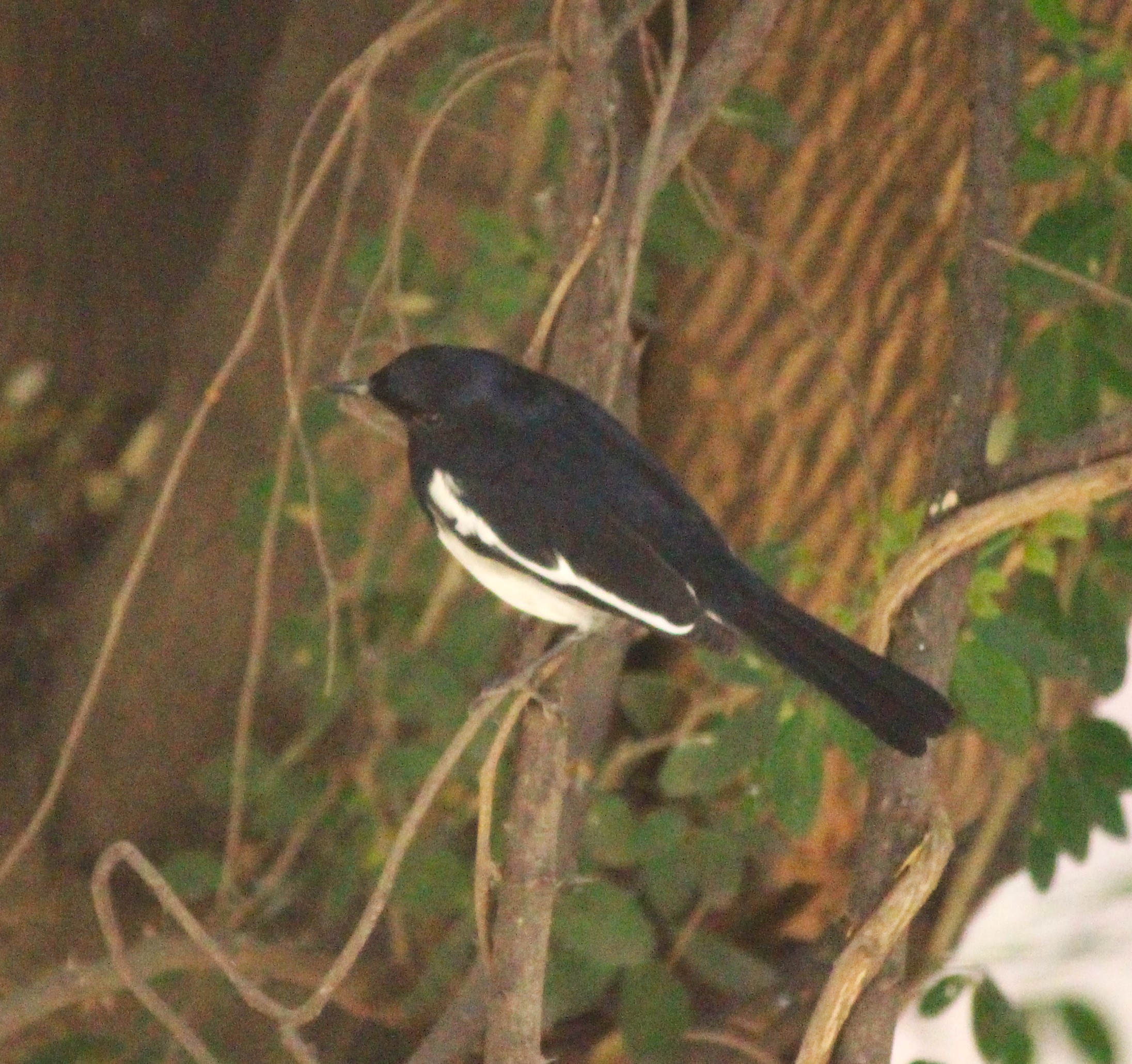
Harini gets to know why Dominga and Domingi, the magpie robins, are upset with one another

Harini gets to know why Dominga and Domingi, the magpie robins, are upset with one another 

Darzee and Darzi, the tailor birds were puzzled. They could hear the arguments, loud whistling calls that went back and forth between Dominga and Domingi, the Magpie Robins. They had been arguing about something for some time. They were flying about, flitting here and there, amongst the flower bushes below the great old banyan tree at the corner of the garden.

Darzee flew up to Domingi and asked, “What is the matter? Why are you so upset? The two of you will disturb the entire garden and the other birds inside the banyan tree. Did something go wrong?”

Domingi gave a sharp whistle, and pointed towards her partner. “It is Dominga. He will simply not listen. I have told him to be careful and yet, he slips up. You know that we have to absolutely protect our nests and eggs. I am helpless when I am in the nest. It is Dominga, when he is flying about, who has to keep a watch and be on the alert.”

“I hope you are not anywhere near the nest now, while you are whistling and arguing so loudly,” Darzi asked Dominga. “That would be very foolish. Everyone, the birds, especially the crows, hidden away in the tall Asoka trees in the neighbouring garden, are all watching, looking at you.”

Dominga whistled, an angry tone, loud and shrill, and quietened down, perched on the branches of the Chafa tree, away from the banyan tree and the flower bushes below it. “No, No. We are not near the nest. Even Domingi is away from it. I was not careful today but Domingi blames me every day.”

Meanwhile, Harini, the 4-year old girl, hearing the loud whistles and calls of the Magpie Robins and watching them fly about with the two tailor birds, walked out of the house and came up to the Chafa tree. Darzee flew out of the banyan tree and came to a branch near her and called out, softly.


Harini saw Darzee, and said, “I hope everything is ok. If you want, I can go and call my Daddy. He will come out and scare it away, whatever is frightening you all and making you upset.”

Darzee laughed, in a musical whistle, “No. There is no need to call anyone. We cannot depend on you or your Daddy to help us. We have to help ourselves and manage it amongst us. Come, let me introduce you to Dominga. He did something wrong, like he does, every day. Domingi is angry.”

Darzi and Dominga flew down to the lower branches and perched nearby. Darzee asked, “What did you do wrong, Dominga? Even Harini, our friend in the garden, she who watches us from her window above the Chafa tree, is very curious. She wants to know if she can help us if you want her to.”

Dominga whistled in a low tone, “Hello, Harini. I have seen you at your window and while you were walking about in the garden. I know that you talk to Darzee and that the two of you are good friends.”


Harini smiled, and asked, “What happened? All of a sudden, there were these many loud whistles.”

“It was Domingi, my partner, who was upset,” Dominga replied. “I was not alert. It seems that Kokila, the female partner of the Koel, came quite close to our nest. I was watching Koel and looking out for hidden crows. I did not notice Kokila moving about stealthily, almost unseen, searching for nests.”

“Why are you so worried about Koel and Kokila,” Harini asked. “They are very quiet and never seem to talk to the other birds. They are always hidden in the large trees in the other gardens and are very rarely seen in the chafa tree. But, they never come to the bird feeder or to the bird bath.”

“The quieter that they are, Koel and Kokila,” Darzi said, looking around warily, “the more dangerous that they are. They search for our nests and we are always careful with them. Kokila is very clever. She is never seen but if we are not at our nests, she will come in and remove one of our eggs and replace it with her own. She will throw away our egg. She is very stealthy. We will have a big loss.”

“Kokila will steal your eggs?” Harini gasped. “How terrible. Why does she do that? Please go and talk to Domingi. She must be very frightened.”

Darzee nodded, and said, “I will let you know all about Koel and Kokila, sometime later. Now, let me go and talk to Domingi.”


The fifth of the very short stories about the birds in Harini's garden 

Bharat Bhushan 11 April 2025


Harini listens to the song of Dominga, the Magpie Robin


Harini’s mother looked angry. “Come on, eat up your breakfast. We need to get you to your kindergarten school in time. You may be punished for being late.”

Harini knew her strategy well for such moments. She put up her innocent face, pouted slightly, and spoke in a sing song voice, “Let me sit in Daddy’s open jeep in the garden and eat my breakfast. I will finish it quickly. We can go to the school directly from the garden after you get ready.”

Before waiting for her mother to answer, Harini picked up her breakfast plate, spoon and water bottle and ran out to the garden. She had prepared for it, already. A wooden box was kept in place for her to climb on and get in to the front seat of the open jeep. She could now have her breakfast and also take a look around the garden and see if she could spot any of the birds or butterflies or grasshoppers. Some portion of the Chafa tree’s shadow came over the vehicle and Harini was happy about it.

Sure enough, the male Magpie Robin, the handsome black and white colored bird, was perched on the outer branches of the Chafa tree and calling out in song, in a shrill, loud tone, with long whistles. ‘Wonder why was he calling out so loudly,’ thought Harini. ‘Darzee had told her that the tailor birds had different reasons for their many short and long whistles and calls. Did the Magpie Robin also change its calls?’


Waving her spoon, Harini called out to the Magpie Robin, “Why are you calling out so loudly, so early in the morning? Do you want some breakfast? I can share some of my fruits and milk.”

The Magpie Robin did not reply. From a nearby branch, Darzee, the female tailor bird, flew down to the bonnet of the jeep and looked inside Harini’s breakfast plate.


Darzee said, “That is Dominga, the male Magpie Robin. He is usually very busy in the mornings and evenings in calling out with his very loud display call. What are you eating? That looks very funny. Do you want me get you some insects and flowers to eat?”

Harini laughed. “Yes. I would love to show the insects to my mother and tell her that I am going to eat them. She will scream in fright. Why is Dominga, the male Magpie Robin calling out so loudly? Is he threatening the other birds and warning them not to come to the Chafa tree?”

“Dominga is just like that,” Darzee replied. “He calls out to the other male Magpie Robins and tells them that he is at the Chafa tree and that the others can go to some other trees. But, he is usually calling out to Domingi, the female Magpie Robin, who is at her hidden nest, on their eggs, and being careful about letting anyone know her location.”


“Oh! That is so wonderful. Another nest!” Harini clapped her hands. “Do you know where is it?”

Darzee whistled in mock anger. “Yes. I know where Domingi has her nest. No. I will not show you the nest or point it out to you. The nest will be in danger. There are always others who are watching, waiting for us to make a mistake. They even notice the direction that you are pointing to, and also can wait very patiently.”

“Yes, Yes. You had warned me,” Harini said. “I have to go to school now, and will return at noon. Can you get me to talk to Dominga and Domingi? I love Dominga’s song. Why does he sing?”

“I guess he is being clever,” Darzee said. “He is singing loudly so that all the hidden watchers are looking at him. Domingi can quietly get out of her nest and flit about the low bushes before she allows herself to be seen in the upper branches.”

“That is very smart,” Harini replied. “There, my mother is coming over to pull me out of this vehicle. I will meet you when I return from school. I love Dominga’s long whistling song. Let me try and practice that when I am going to school.”

Bharat Bhushan

11 April 2025

Darzee explains to Harini about how the tailor birds talk to one another.

Harini walked back to the great big old banyan tree and its wonderful canopy with all the flower bushes, grasses, weeds and thorny rose bushes that had gone wild by the corner of their garden. She did not want to disturb Darzee and Darzi, the tailor birds, at their nest. So, she walked carefully away from the bush that had the nest and came up to the tall rose bushes.

She called out softly, singing the nursery rhyme that was taught in school today. It went something like, 'Mary had a little lamb', or whatever. She was happy singing her own song, 'Meera had a sparrow,' a nursery rhyme that she had made up all by herself while returning on the school bus.

Darzee flew out from her flower bush and went about perching on 3-5 other bushes before coming nearer to Harini.


Darzee asked, "What is it that you are singing? I could hear it as you walked by the banyan tree. Thank you for not coming nearer to our nest."

"Oh, that's just a song that I made up," Harini replied. "But, you and your family, the other tailor birds, are always whistling and singing whenever you are flying about in the Chafa tree near my bedroom window and also in all the flower bushes. Why do you keep whistling?"

"Whistling?" Darzee smiled. "Yes. That is the way we talk to one another. There are many whistles and each one means something different. That is our language."

"Wow! You talk through whistles?" Harini exclaimed. "I would love to learn that. My father would be puzzled if I start talking to him by whistles. I could teach that to my friends in school."

Darzee laughed, in a long whistle. "It is easy to learn, if you sit quiet, observe, watch us carefully and understand why we whistle out the way we do. The short whistles are contact calls. We use that to let other tailor birds know that we are close by, though they may not easily see us inside the bushes."

"But, you have that other long musical whistle, very loud, that I love to hear," Harini said. "I know that it is the call of the tailor bird, 'towhee-towhee-tweee-tweee-towhee', or something like that. I am trying to learn that and will soon call you with that whistle from my bedroom window.

"Yes. But we have several different ones, when we call out loudly," Darzee replied, laughing. "I will not tell you about them so easily. You need to listen carefully, and watch out for what we are doing at that time."

"I did hear some different ones," Harini said. "Whenever I hear the long call, I know it is you and your family. It is only after I observe you all for some time that I hear the other calls and whistles. How do you know which one is which?"

Darzee laughed in her typical short whistle. "The calls and the whistles, these are certainly what we learnt from our parents, I think. They would call out when we flew together, and sometimes, they would call out in a short and loud whistle, one burst, and would stop. We would all stop. We do not know if there was danger about, but we knew that whistle very well."

"But, all tailor birds have the same sort of whistles, long or short, musical or not," Harini said. "How do you know that they are your parents or the tailor birds from another family? Do you all not get very confused?" 

"We make sure that we stay in eye contact, mostly," Darzee replied. "Tailor birds from other families do join us, whenever we announce that a certain tree or a branch within the banyan tree has a long line of ants or other insects moving about. We like to share with the others, you know. The other birds, those that love to eat ants and insects, they also join in. I do not know how they know but they do know that there is good feeding nearby." 

"Ok, I understand," Harini smiled. "I will keep a close watch on you and your family. Let me see if I am able to understand your calls and whistles."

Darzee continued, "Let me know if you can guess the purpose of each whistling call. I will also ask Darzi to tell the other tailor birds to call out loudly whenever they see you in the garden or at your window."

Harini smiled and was very happy. This was going to be fun, learning about the way the tailor birds talked to one another.

Bharat Bhushan
10 April 2025

Harini learns how the tailor birds decide to make their nests

Harini sat at her bedroom window, gazing out at the garden and the great big banyan tree in the distance. She loved watching the birds flit about, their feathers a riot of colors against the lush green foliage. Her eyes drifted to the shallow bird bath she had placed near her window, and she smiled as she saw a few birds sipping water from its edge.

As she sat there, keenly observing, she noticed the tailor birds flitting about the chafa tree that grew closer to her window. The inner canopy of the tree was a favorite haunt of the birds, darting in and out of its leafy depths. Harini loved watching them since the upper canopy of the Chafa tree was just outside her bedroom window on the first floor.


One of the tailor birds flew out of the Chafa tree and came to perch on the windowsill, looking in at Harini with bright, curious eyes. It was Darzee, the female Tailor Bird.


"Hello, Harini!" Darzee chirped. "Why did you not come to the banyan tree today? We were expecting you."


Harini smiled, feeling a little guilty. "I just got back from school, and I was waiting for lunch. I will come to the garden later this evening, I promise."


Darzee nodded, seeming to accept Harini's explanation. "We were a bit worried about you," she said. "But we are glad you're okay. By the way, what is a 'school' that you said you went to?"


"A school?" Harini asked. "Do you not know what is a school? That is where we are sent to learn everything. Nowadays I am learning alphabets and some poems. My father said that as I grow older, I can learn engineering and medicine. Then I can construct big buildings or learn how to treat people who are ill." 


"Don't you birds have a school?" Harini asked. 


"No. We do not attend a school and we have no teachers," Darzee replied. "All tailor birds know that as they grow older, they have to, with their partner, select a bush with large leaves that will not wither or fall away, look for a strong branch, avoid locations that can be seen easily, and stitch up the leaves to make our nests."


"But how do you learn to do this?" Harini asked. "How do you know which leaves to choose? How do you know how to stitch them together? I guess you have to protect them from the rain and the sun. I get so upset when it is very hot outside. But, I enjoy the rain."


"We cannot risk the rain or the sun," Darzee said. "The eggs have to be carefully protected. The body heat from our bodies is enough. Not more than that. The rains will make the entire nest wet and heavy and will cause it to fall down. So we have to choose carefully. Nobody teaches us. We learn by watching other tailor birds select their nest locations and also by observing the nest material that they pick up with great care. The stitching of the leaves, well, we do not go to any school and our parents certainly do not teach us."


"Nobody teaches you this?" Harini asked. "I thought that your mother taught you all this when you were in the nest. You are amazing, Darzee. I am so happy that I met you. I can learn so much by just watching you." 


Darzee laughed in a whistling tone and flew off to join her family at the Chafa branches as they kept searching for insects. Harini waved at the tailor birds and she was sure that one of them waved back at her.


Bharat Bhushan

8 April 2025